News & Media
Weems Memorial Hospital now offers digital mammography services thanks to a $258,500 USDA Rural Development Health Care grant and a matching donation of $137,250 from Franklin Needs, Inc., a local nonprofit organization that helps fund breast cancer support services for Franklin County residents.
For the past 10 years, Franklin Needs has hosted the annual Pink Out event on St. George Island that raised money to help fund mammograms and breast cancer support services. President Jessica Sparks said that in addition to the donation for the mammography equipment, the group has committed to help cover ongoing costs associated with the equipment and services. “We’re not a big community but when we come together, we do big things,” she said.
“The sooner you discover breast cancer, the better your odds are for full recovery,” said Dr. Patrick Conrad, Weems Emergency Room Director. “Early detection is key and while monthly self-exams are important, a mammogram can pick up tumors that the most careful self-exam will miss. If you are over 35, or if women in your family have had breast cancer, talk to your primary care provider today about whether you should have a mammogram. The sooner you look for it, the sooner you can cure it.”
Franklin Needs is a non-profit organization committed to providing free mammograms and help with qualifying expenses for under-insured and uninsured residents of Franklin County, Fla. For more information or to inquire about assistance call (678) 772-7304 or visit their website www.franklinneeds.com.
Equipment
The GE Senographe Pristina 3D Mammography system provides outstanding detail and superior diagnostic accuracy with the same low dose as a 2D exam.
COVID-19 Visitor Policy
To protect our patients and colleagues at Weems Memorial Hospital from the spread of coronavirus (COVID-19), we continue to modify our visitor policy to meet the changing needs of our patients and community. Our team is working to ensure families stay as connected as possible. For the safety of our patients and colleagues, we are doing our best to limit visitors and minimize entries and exits. However, we understand the benefits of our patients having a care partner as part of their healing process. A care partner is someone the patient chooses to be involved in their care. For this reason, we’ve established the visitor policy below. (Effective 1/6/2022)
One (1) visitor per patient per day during visiting hours is permitted.
Visiting hours are 7 am-7 pm.
All visitors must meet the requirements listed below before entering and while inside the facility.
• All permitted visitors must undergo a health screening upon entering the facility. Those who don’t pass this screening will not be allowed entry.
• All visitors must properly wear an approved protective face mask while in the hospital. If you do not have one, we will provide one upon entry. If a visitor is non-compliant with properly wearing a mask, they will be asked to leave.
• All visitors must follow the CDC’s guidelines on handwashing and social distancing.
• Patients who are at end-of-life will be allowed a maximum of three (3) visitors at one time.
• Visitor access is limited to (a) their final destination (patient room).
• Patients who are known COVID-19 positive or under investigation for COVID-19 will not be allowed visitors.
• Patients requiring a care partner or visitor past 7 pm will be addressed on a case-by-case basis (including end-of-life, specific care givers and special needs).
• A sitter hired by the patient or patient’s family is not deemed a visitor, but part of the care provider team serving the patient.
• A member of clergy or a religious leader may visit a patient in addition to one visitor per day.
• No visitors under age 16 barring extenuating circumstances.
Inpatient Visitor Policy
Throughout the COVID-19 pandemic, Weems Memorial Hospital has been managing the delicate balance of surrounding our patients with the healing support of loved ones while limiting the risk of exposure to the virus. With the recent surge in COVID-19 cases in our community, we have reevaluated our visitor policy with the safety of our patients and colleagues in mind. After careful consideration, the visitor policy is temporarily adjusted to allow only one visitor per patient per day. (Effective 1/6/2022)
Visitors should know:
1. Inpatients can have one visitor per day during visiting hours.
2. All visitors are still required to pass a screening and wear a mask.
3. Visiting hours remain 7 am to 7 pm, with clearly defined exceptions.
Emergency Department Visitor Policy
• The Emergency Center Entrance is for Emergency Patients and their visitor only.
• One visitor per patient, per visit. There will be no rotating visitors at this time.
• Visitors may not re-enter without authorization from nursing staff.
• Waiting area is only available to patients.
• No visitors will be allowed for COVID-19 positive patients.
• Masks must be worn by both patient and care partner for the duration of the visit unless, medically contraindicated.
• Once a patient is admitted, the inpatient visitor guidelines apply, including visiting hours.
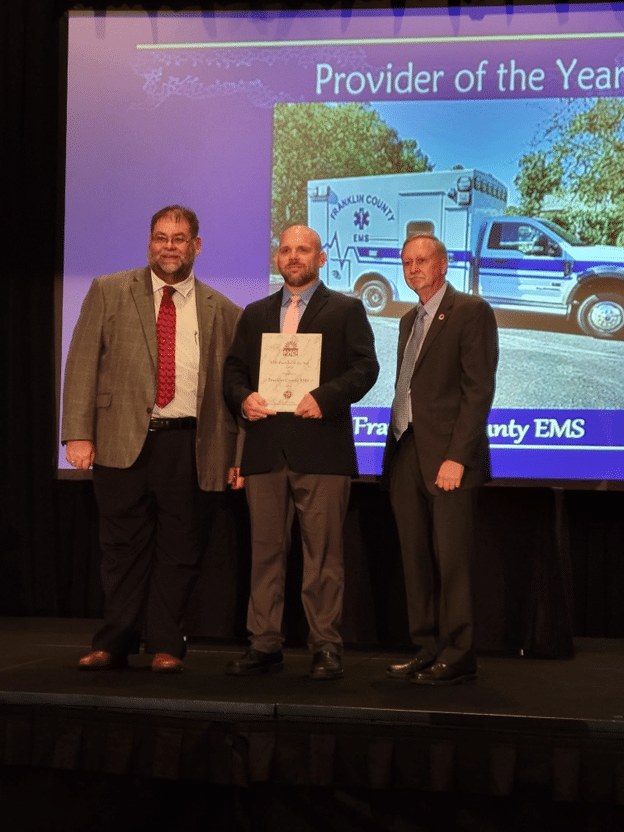
Franklin County’s Ambulance Service was awarded 2021 EMS Provider of the Year by the Florida Department of Health. This annual award recognizes an EMS provider that has assumed a leadership role in the Florida EMS system and community; has demonstrated outstanding initiative in public education and/or training; and has demonstrated excellence in the areas of quality assurance/improvement and medical control protocol development/implementation.
The award was accepted by Richard Lewis, EMS Director for Franklin County’s Ambulance Service.